

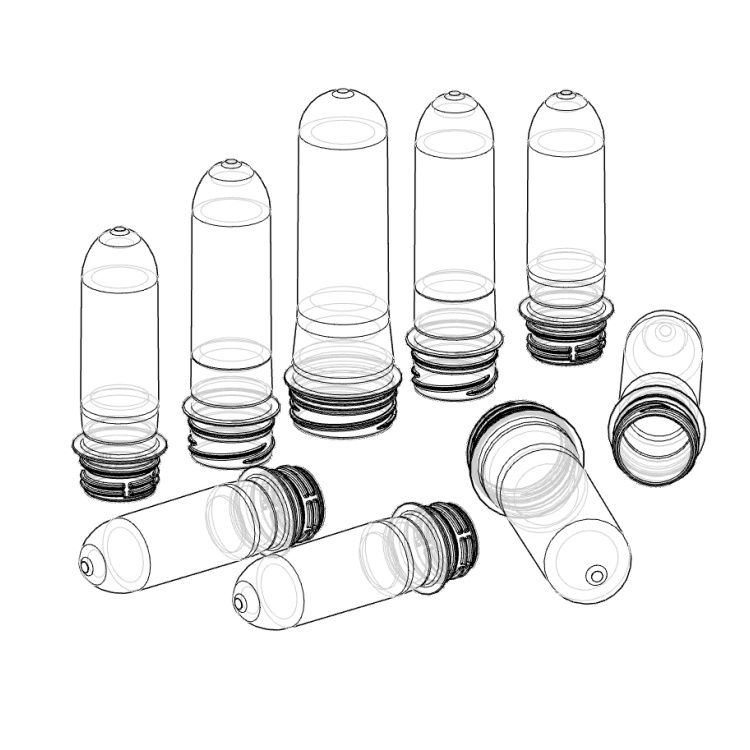
Water Bottle Blowing Machine Basics for Beverage Packaging Projects
A water bottle blowing machine turns a heated PET preform into a finished bottle through controlled heating, stretching, pre-blowing, high-pressure blowing, cooling, and release. For beverage packaging buyers, however, choosing the machine is only one part of the project. Bottle capacity, preform design, mold compatibility, cooling conditions, required output, and downstream filling and capping all affect whether the line will run consistently.
BJY focuses on PET liquid packaging molds and machine-related parts for beverage production. Its work covers PET blow molds, preform molds, machine parts, bottle design support, and equipment adaptation. This is especially relevant when a buyer needs the bottle, mold, and existing production platform to work as one system rather than treating the blowing machine as an isolated purchase.
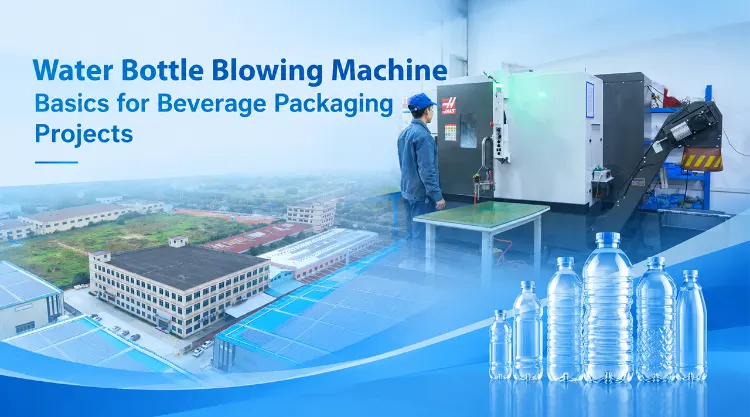
How Does a Water Bottle Blowing Machine Form a PET Bottle?
The basic blowing sequence looks simple, but stable production depends on several stages working together. A PET preform enters the heating system, where infrared lamps raise the body of the preform to the required forming temperature while the neck finish is protected from excessive heat. The heated preform then moves into the mold.
A stretch rod extends the preform in the axial direction. Pre-blow air starts expanding the material, followed by high-pressure air that pushes the softened PET against the mold cavity. The bottle is held long enough to stabilize its shape before pressure is released and the finished bottle leaves the blowing station.
For a closer look at how heating, stretching, blowing, mold cooling, and tooling accuracy come together during bottle production, see Inside the Art of PET Bottle Blow Molding. It provides additional context on how mold design and process control influence bottle consistency in real production.
Pre-Blow and High-Pressure Control
Pressure consistency matters more than simply selecting a high setting. For bottles around 500ml, practical pre-blow pressure may fall in the range of about 7–12 bar. Station-to-station variation should remain close to ±0.1 bar where possible because unstable pre-blow conditions can change material distribution between the shoulder, body, and base.
For water bottles, high-pressure blowing commonly operates around 28–38 bar. Variation between stations should remain close to ±1.0 bar. Large pressure differences can affect bottle volume, shape consistency, and final mechanical performance.
Cooling Conditions
Cold-fill water bottle molds also need controlled cooling. A typical mold cavity may operate around 25–45°C, while the base mold can run around 7–12°C. The important point is consistency. Temperature differences between mold stations should generally remain within about ±1.5°C so one cavity does not begin producing bottles differently from the others.
These values are commissioning references rather than fixed settings for every bottle. Bottle geometry, preform weight, output speed, and equipment design still determine the final process window.
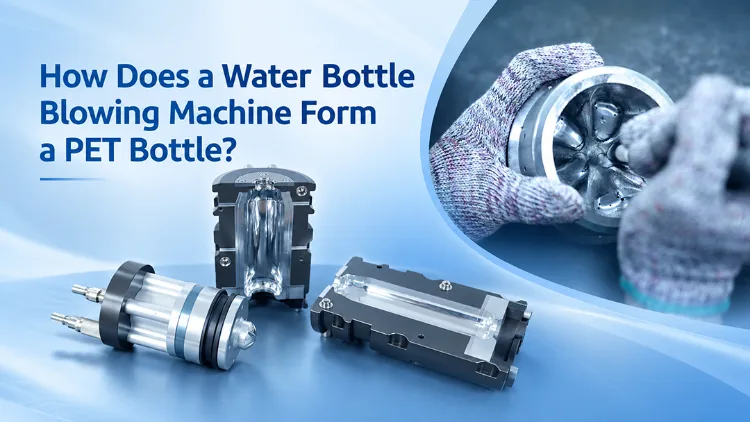
What Does a Water Bottle Blowing Project Need?
A bottle blowing project needs a clearly defined bottle target, compatible tooling, stable machine conditions, and a plan for what happens after the bottle leaves the mold.
A bottle may look acceptable during a short mold trial but still create problems at filling, labeling, capping, packing, or transportation. For this reason, the project should be evaluated as a complete packaging line rather than only as a blowing machine purchase.
Output Target and Bottle Format
The buyer should first define bottle capacity, bottle shape, preform specification, neck finish, and required production output. A low-volume specialty bottle and a high-volume standard water bottle require different cavity strategies and changeover priorities.
End use also matters. Bottles for retail coolers often require stable label panels and familiar handling characteristics. Bottles supplied to hotels, schools, events, or contract packing operations may place greater emphasis on compact dimensions, carton efficiency, or frequent format changes.
These decisions should be made before final mold drawings are approved.
Mold and Machine Match
The mold must match the exact machine platform rather than only the general type of blowing machine. Buyers should confirm the machine model, generation, mold height, mounting interface, bottom mold structure, cooling connection, and cavity arrangement before production begins.
BJY’s PET blow mold range covers bottle volumes from approximately 50ml to 2500ml for multiple rotary blowing platforms. Cold-fill molds can use ALCOA A6061 or A7075 aluminum, while selected applications use S136 stainless steel components with A6061 bases. Product specifications for many mold families list service targets of up to 10 million cycles when operated and maintained correctly.
Utility and Line Planning
The blowing machine also depends on compressed air, cooling water, electrical supply, preform handling, and maintenance access.
A production layout that looks efficient on paper may still create daily problems if cooling lines are difficult to inspect or high-wear parts cannot be replaced without stopping a large section of the line. Buyers should therefore review utilities and service access before treating the machine layout as final.
Which Mold and Machine-Adjacent Parts Matter Most?
The blow mold shapes the bottle body, shoulder, and base, but daily production stability also depends on the components feeding, positioning, stretching, cooling, and releasing the bottle.
Mold Design and Cavity Count
Cavity count affects theoretical output, but cavity number alone does not guarantee production capacity. Cooling balance, machine speed, air pressure stability, and bottle release also determine how fast the system can operate without creating rejects.
For a compact water bottle, 335ml PET Bottle Blow Mold remains a useful product reference when capacity, cavity arrangement, bottle geometry, and machine output need to be considered together.
The mold should also support stable material distribution. Poor cooling or an unsuitable base design can lead to thin areas, bottom eccentricity, whitening, or inconsistent bottle strength even when the nominal capacity is correct.
Feeding and Handling Support
Preform and bottle handling should remain stable from feeding through discharge. Misalignment, inconsistent preform pickup, or poor bottle transfer can cause scratches, drops, and distorted handling even when the blowing process itself is correct.
Handling problems can also make a mold issue look worse than it really is. During troubleshooting, production teams should separate mold-related defects from preform feeding or transfer problems before modifying tooling.
OEM Parts for Steady Runs
Spare parts should be planned before the first failure occurs.
The practical questions are which parts wear first, which components should be stocked at the plant, and which items require supplier support or custom machining. Small mechanical parts can stop an entire packaging schedule when no replacement is available.
For that reason, OEM Machinery Parts should be evaluated together with the mold rather than after the production line is already running.
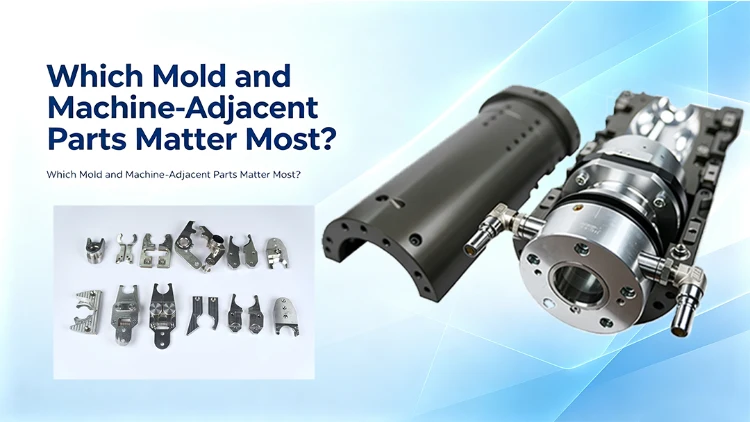
How Do Bottle Size and Output Target Change the Setup?
Bottle size affects stretch behavior, heat distribution, cooling demand, cavity selection, and production rhythm. A machine that runs a 335ml bottle successfully cannot automatically run a larger format at the same conditions.
Small Bottle vs Larger Bottle
Smaller bottles may support more aggressive cavity planning, but they still require stable preform positioning and material distribution. Larger bottles generally place more demand on axial stretching, base formation, and cooling.
The pre-blow requirements can also change. For bottles around 500ml, practical pre-blow pressure may be around 7–12 bar, while bottles near 1.5L can require approximately 9–14 bar depending on design and machine conditions.
The process window should therefore follow the actual bottle rather than a copied recipe from another format.
Production Rhythm
Fast production requires more than increasing machine speed. The mold must release the bottle cleanly, cooling must recover quickly, and every station must maintain similar temperature and pressure conditions.
If one mold station runs hotter or one pre-blow station behaves differently, the line may still appear to be operating normally while producing inconsistent bottles.
A stable production rhythm is therefore a balance between cycle speed and repeatability.
Maintenance and Changeover
Maintenance should be scheduled by operating condition instead of waiting for visible damage.
For continuously used PET blow molds, forming surfaces and parting areas can be cleaned around every 72 operating hours. Guide pillars, guide bushes, and base-mold sleeves should also receive regular food-grade lubrication. Cavity polishing may be scheduled monthly or after roughly 500 operating hours, while cooling passages should be checked at least quarterly for scale or blockage.
Cooling passage contamination is particularly important because poor heat transfer may begin affecting bottle quality long before obvious mold damage appears.
What Should Buyers Check Before Purchasing?
The final purchasing check should focus on actual compatibility, bottle requirements, maintenance planning, and the supplier’s ability to verify tooling rather than relying only on catalog descriptions.
Compatibility With the Current Line
For an upgrade project, buyers should provide the exact machine model and generation, not just the machine family.
Different generations of rotary equipment can use different mold heights, mounting structures, cooling arrangements, and base mold assemblies. A mold can be manufactured accurately and still fail during installation if those interfaces were not confirmed before machining.
Upgrades and Spare Parts
When an existing line is being modified, the buyer should confirm whether the project really needs a complete new mold.
Some bottle changes can be handled through replacement components, modified bottom mold structures, mold shells, stretch rods, limit components, or other adaptation parts.
Custom 570ml Blow Mold Upgrades for KHS Machines illustrates the type of upgrade discussion that should happen before a buyer automatically orders a completely new tooling set.
Inspection and Trial Validation
Tooling accuracy should also be verified before shipment.
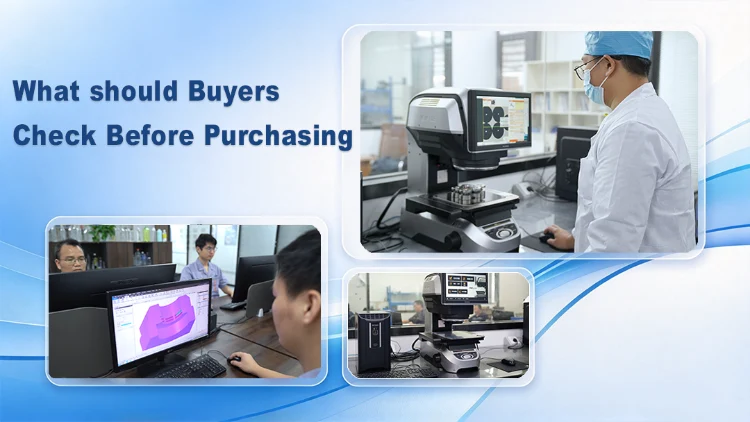
BJY uses inspection equipment including hardness testers, thickness gauges, pressure testing equipment, image measurement systems, and a Zeiss coordinate measuring machine with detection accuracy reaching 0.002mm. The company also operates mold testing systems that can support small-batch bottle trials and inspection before final delivery.
This matters because drawings alone cannot confirm every production condition.
After-Sales Response
Even a correctly manufactured mold may require adjustment during commissioning. Buyers should confirm how technical questions, drawing changes, installation support, and trial problems will be handled before placing the order.
Response capability becomes especially important when the new mold must be introduced without interrupting an existing beverage schedule.
What Should Buyers Clarify Before They Treat the Setup as Final?
A project should only be treated as ready when bottle design, tooling, machine conditions, and production responsibilities have been confirmed together.
Bottle Drawing Review
The bottle drawing should function as a production document rather than simply as a visual concept.
Volume, body diameter, shoulder shape, base structure, label panel, neck finish, and preform selection should all be checked before mold machining starts.
The neck finish is especially important because it must remain dimensionally stable through heating and handling so filling and capping can proceed correctly later.
Installation and Adjustment Conditions
Before production starts, mold installation height and alignment should be checked carefully.
BJY technical guidance calls for individual mold station horizontal height control around ±0.05mm, with the horizontal difference between the two mold halves controlled within about 0.03mm. After heating, mold closing clearance may be adjusted to roughly 0.07–0.12mm to reduce excessive parting lines and poor mold locking.
These details show why installation should not be treated as a simple bolt-on task.
Start-Up and Adjustment Window
The first production run should include time for adjustment.
During commissioning, several bottles from each mold station should be checked. If defects consistently follow one mold number, the problem may relate to that station, mold, stretch system, pressure, temperature, or ventilation. If defects appear randomly across different stations, utilities, preform quality, heating stability, or general machine conditions should also be investigated.
This approach helps production teams avoid modifying a good mold to solve a machine-side problem.
Conclusion
For a beverage packaging project, choosing a water bottle blowing machine should start with the bottle rather than the equipment catalog. Confirm bottle capacity, neck finish, preform specification, required output, filling method, exact machine platform, mold configuration, cooling conditions, and spare-part requirements before tooling is approved.
A standard cold-fill water bottle line and a line requiring frequent product changes do not need the same purchasing logic. High-volume projects should place more weight on pressure consistency, cooling balance, mold compatibility, inspection capability, and local spare-part planning.
BJY’s PET blow molds and OEM Machinery Parts fit projects where the machine interface, bottle tooling, maintenance requirements, and future line adjustments need to be evaluated as one production system.
Planning a new water bottle project or adapting tooling to an existing production line? Contact BJY with your bottle size, drawing, preform specification, machine model, and expected output so the mold and line requirements can be reviewed together.
FAQ
Is a bottle blowing machine enough by itself?
No. The mold, preform handling system, compressed air, cooling system, transfer parts, machine compatibility, and downstream filling and capping conditions all influence the final result.
What pressure is normally used when blowing PET water bottles?
For bottles around 500ml, pre-blow pressure may be approximately 7–12 bar. High-pressure blowing for water bottles can be around 28–38 bar, although the final setting depends on the bottle, preform, machine, and production speed.
Why does bottle size affect the machine setup?
Bottle size changes stretch distance, material distribution, heating demand, base formation, cooling requirements, and sometimes cavity strategy. A process developed for one format should not automatically be copied to another.
What should buyers confirm before ordering?
Confirm the bottle drawing, preform, neck finish, machine model and generation, mold interface, cavity count, output target, cooling conditions, filling process, inspection requirements, and spare-part plan.