

What Is the Most Common Plastic Used in Injection Molding and Where Does PET Fit
The most common plastic used in injection molding depends on the product being made. PP, PE, and ABS are common in many general parts, while PET is a key material for bottle preforms and liquid packaging. If you produce beverage, food, personal care, or daily chemical containers, the material question quickly becomes a mold question. A PET injection mold must control preform shape, neck accuracy, cooling balance, and later blow molding performance, not just form a plastic part.
BJY focuses on PET liquid packaging molds and precision mold components. Its work covers PET preform molds, blow molds, closure molds, mold spare parts, bottle shape support, preform design support, and equipment adaptation services. For buyers who already run bottle production lines, the real question is not only “Which plastic is common?” but also “Which mold structure helps this plastic run stably in my production environment?”
What Plastic Is Most Commonly Used in Injection Molding?
There is no single material that fits every injection molding project. A plastic used for a cap, housing, handle, fitting, or transparent bottle preform may need very different strength, shrinkage, clarity, heat resistance, and cost balance. This is why material choice should start from the final product, not from a general material list.
Common Materials Depend on Product Use
PP is often used where light weight and chemical resistance matter. PE is common in flexible or tough packaging. ABS is used in many durable molded parts where stiffness and surface quality matter. PET is more closely linked with clear packaging, especially bottle preforms that later go through blow molding.
For a general factory, the answer to the most common plastic used in injection molding may be PP or PE. For a bottle packaging factory, PET is often the more relevant answer because it connects injection molding with the next production step.
Why PET Matters More in Bottle Preforms
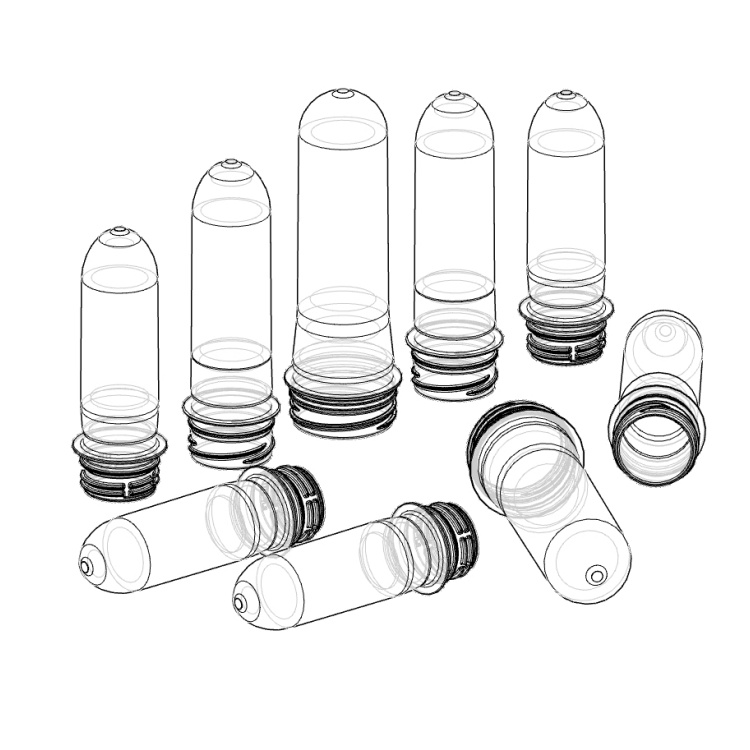
A PET preform is not a finished bottle. It must keep an accurate neck finish, stable wall thickness, and a body shape that can stretch evenly during blow molding. If the preform is not stable, the final bottle may show deformation, uneven capacity, leakage, whitening, or poor strength.
That is why PET preform injection molding needs more than a suitable resin. It needs a mold that can form, cool, and release the preform consistently.
Material Choice Should Follow the Final Package
For injection molding plastic for packaging, buyers should check the end use first. Is the package for water, carbonated drinks, juice, edible oil, cosmetics, household liquid, or pharmaceutical packaging? Does the bottle need clarity, pressure resistance, heat resistance, or a special neck finish? These questions decide whether PET is suitable and what type of mold structure is needed.
Why Is PET Important in Injection Molding for Packaging?
PET is widely used in bottle preforms because it gives a useful balance of clarity, strength, process stability, and lightweight potential. For many liquid packaging projects, PET supports both shelf appearance and practical production needs.
Stable Preforms for Later Blow Molding
In PET preform injection molding, the preform body is shaped first, and the bottle is formed later. A small problem at the preform stage can become a larger problem in bottle blowing. Poor neck accuracy may affect sealing. Uneven wall thickness may affect bottle strength. Cooling imbalance may lead to shrinkage or dimensional instability.
A good mold should help reduce these risks before the preform leaves the injection stage.
Clear Appearance and Reliable Container Strength
PET is often chosen for transparent bottles because it can support a clean appearance while keeping enough strength for common liquid packaging. But clarity is not only a material issue. The mold surface, cooling condition, resin flow, and demolding quality can all affect the final preform surface.
If your factory is producing packaging where appearance matters, the mold core surface, neck area, and cooling structure should be checked carefully.
Strong Fit for Beverage and Daily Chemical Packaging
PET is suitable for many liquid packaging applications, including bottled water, functional drinks, edible oil, personal care products, and household liquids. For buyers serving several product categories, mold flexibility also matters. You may need different preform weights, neck finishes, cavity layouts, or spare parts for future product changes.
This is where supplier experience becomes useful. A mold should match not only the drawing, but also the filling condition, bottle design, equipment setup, and maintenance plan.
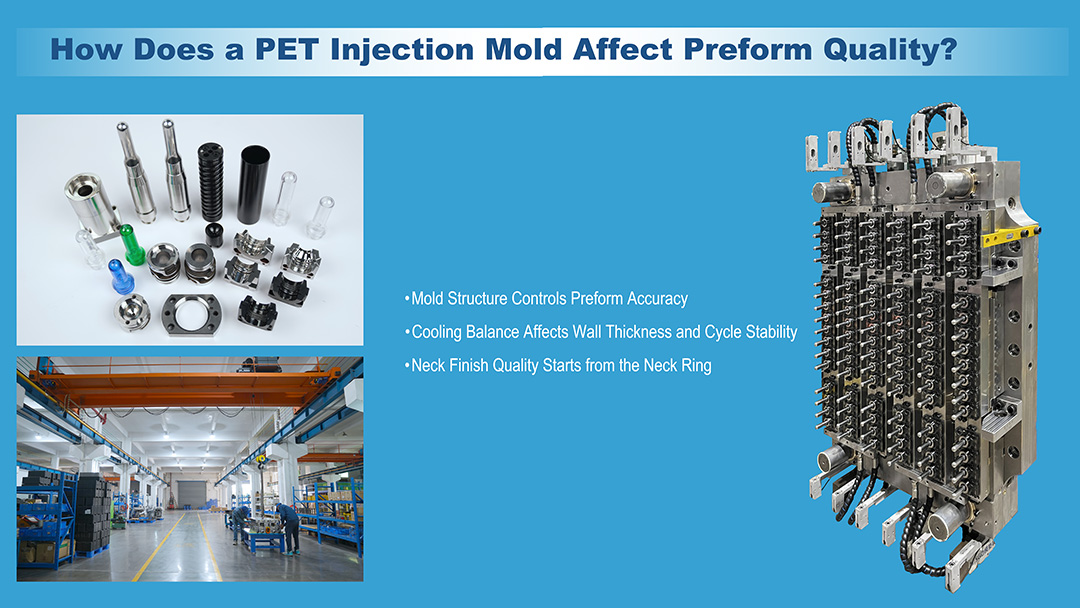
How Does a PET Injection Mold Affect Preform Quality?
A PET injection mold affects how melted PET fills the cavity, how the neck area forms, how heat leaves the preform, and how the finished preform releases from the mold. Many production issues are first described as “material problems,” but the root cause may sit inside the mold.
For example, uneven wall thickness may come from core alignment or cooling balance. Neck leakage may come from neck ring wear or poor sealing surface control. A longer cycle may not only be a machine setting issue; it may also relate to cooling tube performance. Before changing PET resin or process settings, buyers should inspect the mold areas that directly shape and cool the preform.
Mold Structure Controls Preform Accuracy
The mold structure controls the inner and outer preform geometry. If the Mold Core is worn, mismatched, or poorly aligned, the preform may show unstable inner dimensions, wall thickness variation, or demolding problems.
For buyers who see scratches, inner shape changes, or release issues after long production, the Mold Core should be checked before replacing a larger mold section. It is suitable for new mold projects, spare part replacement, and repair work where stable inner forming is required.
Cooling Balance Affects Wall Thickness and Cycle Stability
Cooling is one of the most common hidden factors in preform quality. If cooling is weak or uneven, the factory may face longer cycles, uneven shrinkage, or preforms that change after ejection. Buyers sometimes adjust machine settings again and again, while the real issue may be cooling flow, cooling tube wear, or cooling channel blockage.
BJY’s Cooling Tube Assemble is designed for PET preform mold cooling. It is worth reviewing when cycle time becomes unstable, cooling response slows down, or the preform shows uneven shrinkage.
Neck Finish Quality Starts from the Neck Ring
The bottle neck is already a functional area at the preform stage. It must match the closure and support sealing after filling. If the neck thread, support ring, or sealing surface is unstable, the final bottle may have leakage, cap fit problems, or inconsistent sealing force.
If leakage, cap fit, or neck finish variation appears, the Neck Ring is one of the first areas to inspect. It is especially important for water, beverage, edible oil, personal care, and other packaging where sealing performance affects product safety and storage.
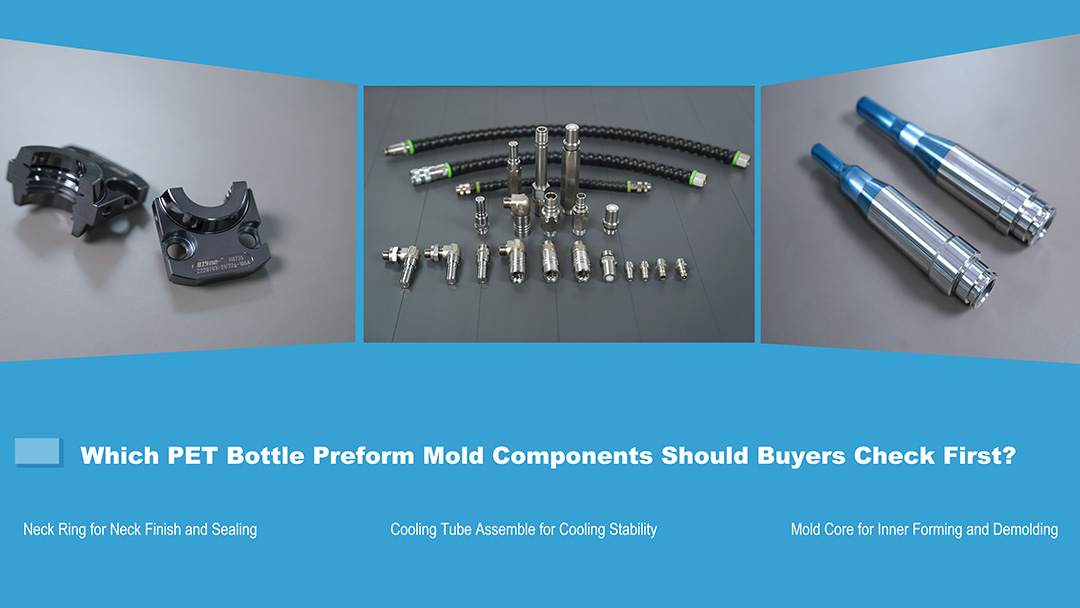
Which PET Bottle Preform Mold Components Should Buyers Check First?
PET bottle preform mold components should not be selected as isolated spare parts. The better way is to match each production signal with the likely mold area. This saves time during troubleshooting and helps buyers avoid replacing the wrong component.
|
Production Signal |
Possible Mold Area |
BJY Product to Review |
Buying or Maintenance Note |
|
Preform inner shape is unstable or demolding is not smooth |
Inner forming surface and core fit |
Mold Core |
Check wear, surface condition, alignment, and whether the core matches the preform drawing |
|
Cap fit, leakage, or neck finish variation appears |
Neck forming and thread area |
Neck Ring |
Review neck finish standard, sealing surface, thread accuracy, and material wear |
|
Cycle becomes longer or preform shrinkage is uneven |
Cooling path and heat removal |
Cooling Tube Assemble |
Check cooling flow, blockage, replacement condition, and whether the cooling design fits the production speed |
Mold Core for Inner Forming and Demolding
If the preform body looks correct outside but has inner forming issues, the Mold Core may be involved. It affects the inner wall, bottom area, and release condition. For repair or refurbishment projects, checking the core first can help avoid unnecessary replacement of a full mold set.
Neck Ring for Neck Finish and Sealing
If the issue appears near the thread, support ring, or sealing surface, the Neck Ring deserves priority. For packaging lines that use different caps or bottle neck standards, buyers should confirm the neck drawing, sealing requirements, and current wear condition before ordering replacement parts.
Cooling Tube Assemble for Cooling Stability
If the issue changes with production speed or long running time, cooling should be checked. The Cooling Tube Assemble helps manage heat removal inside the mold. It is especially relevant for factories that want stable cycles, consistent preform dimensions, and fewer cooling-related defects.
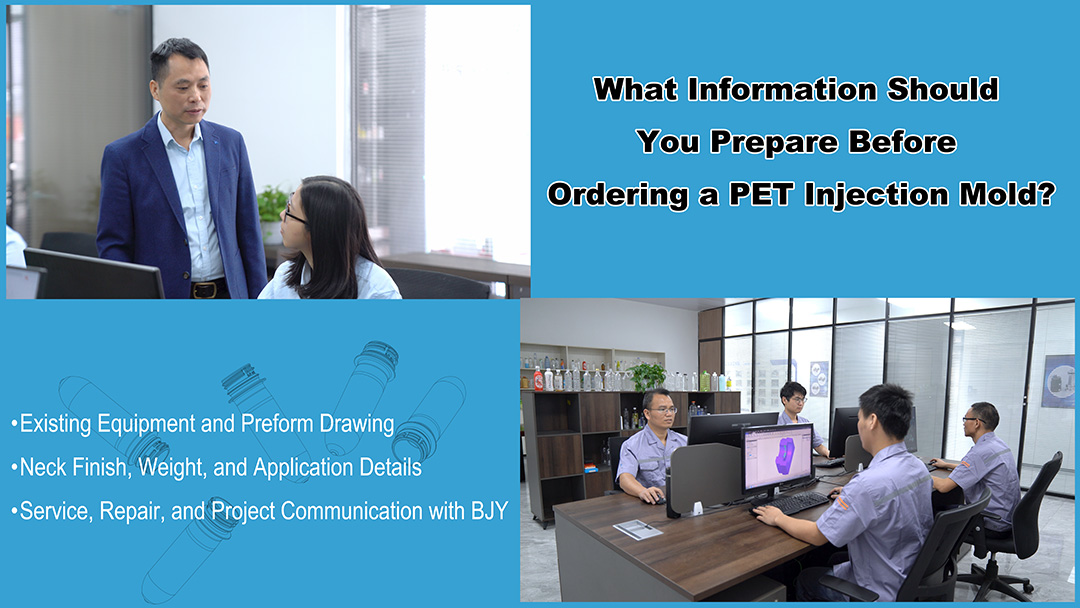
What Information Should You Prepare Before Ordering a PET Injection Mold?
For buyers asking how to choose a PET injection mold, price and cavity count are only the first filter. You also need to check whether the mold can match your existing injection machine, neck finish, preform weight, cooling layout, and maintenance plan.
Existing Equipment and Preform Drawing
Before ordering, prepare your injection machine information, preform drawing, neck finish, cavity layout, and sample photos. If the project is for a replacement part, send the old part drawing or physical sample if available. This helps the supplier judge fit, tolerance, and possible adjustment needs.
Neck Finish, Weight, and Application Details
Tell the supplier what the preform will be used for. A water bottle, carbonated drink bottle, hot-fill container, edible oil bottle, or cosmetic package may need different preform weight, wall distribution, sealing design, and cooling consideration. The more complete the information, the easier it is to avoid repeated mold trials.
Service, Repair, and Project Communication with BJY
If your team is comparing mold options or dealing with preform defects, share drawings, samples, equipment details, and defect photos with BJY through its contact page. Clear project information helps the technical team judge whether you need a new mold, Mold Core replacement, Neck Ring replacement, Cooling Tube Assemble support, repair service, or a wider mold adjustment plan.
For a general plastic part, PET is not always the first material to check. For bottle preforms, clear liquid packaging, and packaging lines that need stable neck size, good transparency, and reliable blow molding performance, PET becomes a practical material choice. If your main problem is preform wall thickness, demolding, neck sealing, or cooling stability, the next step is not only choosing resin. You should check whether the PET injection mold structure and key components match your bottle design, machine setup, and production speed.
FAQ
Q: Is PET the most common plastic used in injection molding?
A: No, although there are a number of different materials used for injection molding, the most common are PP, PE, ABS and others. PET is a very special plastic for bottle preforms and clear liquids for further blow molding.
Q: How do I know if I need a new PET injection mold or only spare parts?
A: Defects that occur inside the mold are most likely caused by the Mold Core, defects that occur at the neck of the bottle could be caused by the Neck Ring, and problems with the cooling of the bottle wall could be caused by the Cooling Tube Assemble. If several parts of the mold fail at the same time, a full mold inspection is required and possibly a new PET injection mold.
Q: What should I send to a supplier before ordering a PET injection mold?
A: The preform drawing, neck finish, preform weight, cavity layout, information on the injection machine, bottle application, sample photos and current defects if any. This then allows the supplier to give an assessment on the required mold design, the fit of spare parts and the production risk.