

What Is the Difference Between PET and PETE for the PET Bottle Blowing Process
If a drawing, resin document, or bottle label says PETE instead of PET, many buyers pause before confirming a mold or preform project. The concern is reasonable: will the material name change the pet blowing process, the mold design, or the final bottle quality? In most bottle manufacturing cases, PET and PETE refer to the same plastic material. The real production risk usually sits elsewhere: preform accuracy, cooling balance, ejection stability, and mold part wear.
BJY works with PET liquid packaging molds and mold components for bottle production lines. Its products cover PET preform mold parts, PET blowing mold parts, and customized components used in actual production. For buyers, this matters because a stable bottle is not decided by the PET/PETE name alone. It comes from the full chain: resin, preform, mold core, cooling, release, and blowing control.
What Is the Difference Between PET and PETE Plastic?
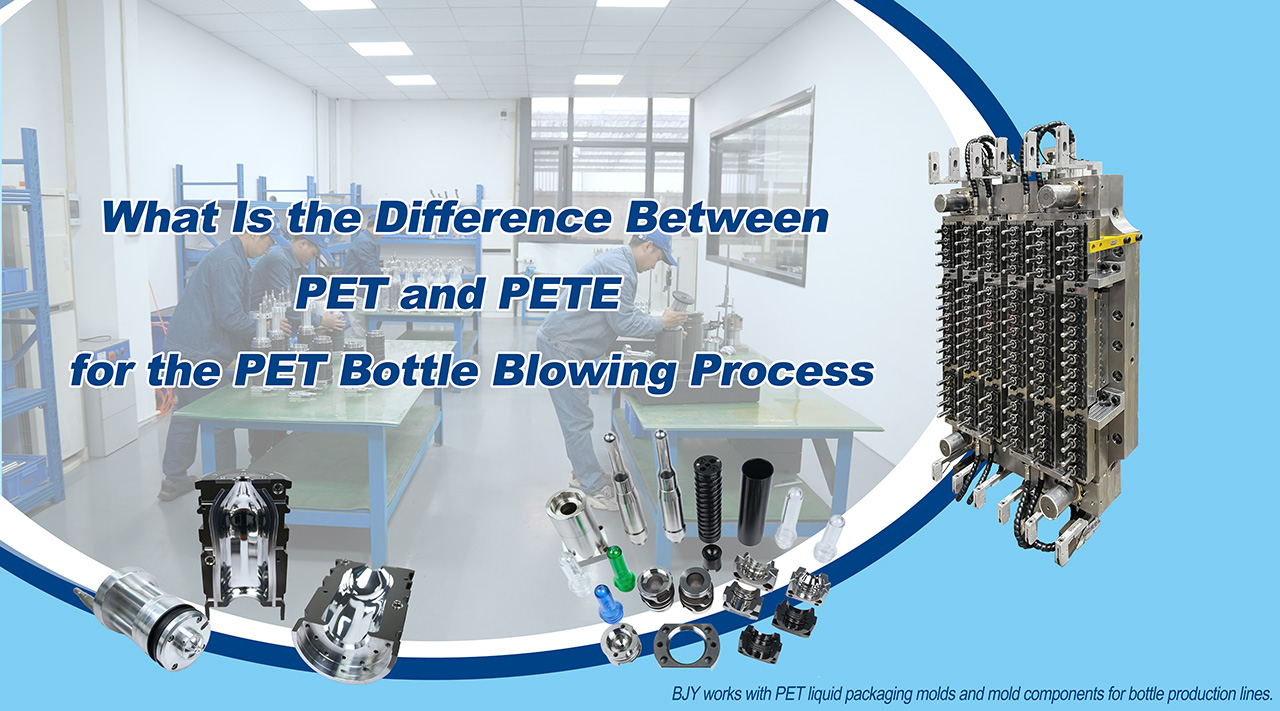
The difference between PET and PETE plastic is mostly a naming issue. PET is the shorter production term for polyethylene terephthalate. PETE is another abbreviation often seen on packaging labels, recycling marks, or material descriptions.
PET and PETE Usually Mean the Same Resin
If your question is “are PET and PETE the same material,” the practical answer for bottle production is yes. In most beverage, food, personal care, and daily chemical packaging projects, both names refer to the same resin family.
That also means PETE does not need a different mold only because the abbreviation is different. If the resin grade is suitable for bottle production, the next checks should move to preform design, heating, stretching, cooling, and tooling condition.
PETE Appears More Often on Labels
PETE is more common in consumer-facing or recycling-related wording. PET is more common in production documents, mold drawings, preform quotations, and factory communication.
For a packaging buyer comparing PET vs PETE for plastic bottles, the question should not stop at the abbreviation. A clearer question is: will the selected preform and mold parts support stable bottle production?
Bottle Quality Depends on More Than the Name
Once the PET/PETE wording is clear, the pet blowing process becomes the more important topic. Poor bottle quality is often caused by uneven preform heating, wrong stretch timing, unstable air pressure, poor cooling, worn ejection parts, or mold component mismatch.
Changing the material name in a document will not solve these issues. Checking the right part of the production system will.
Does PETE Change the PET Blowing Process?
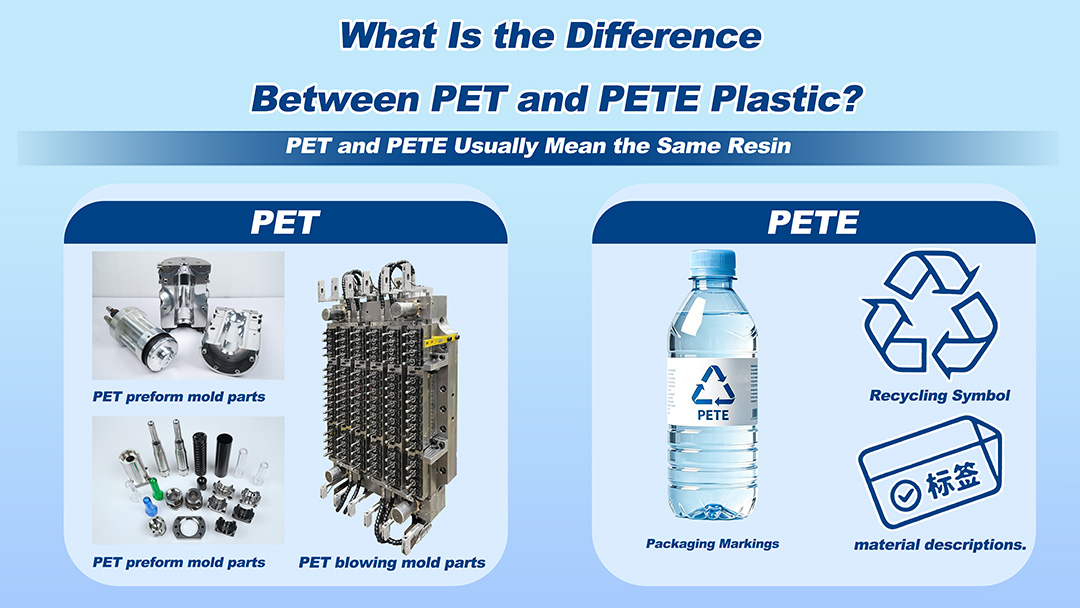
PETE does not change the pet blowing process simply because of the name. A PET or PETE preform still needs to be reheated, stretched, blown with compressed air, cooled inside the mold, and released cleanly.
From PET Resin to PET Preform
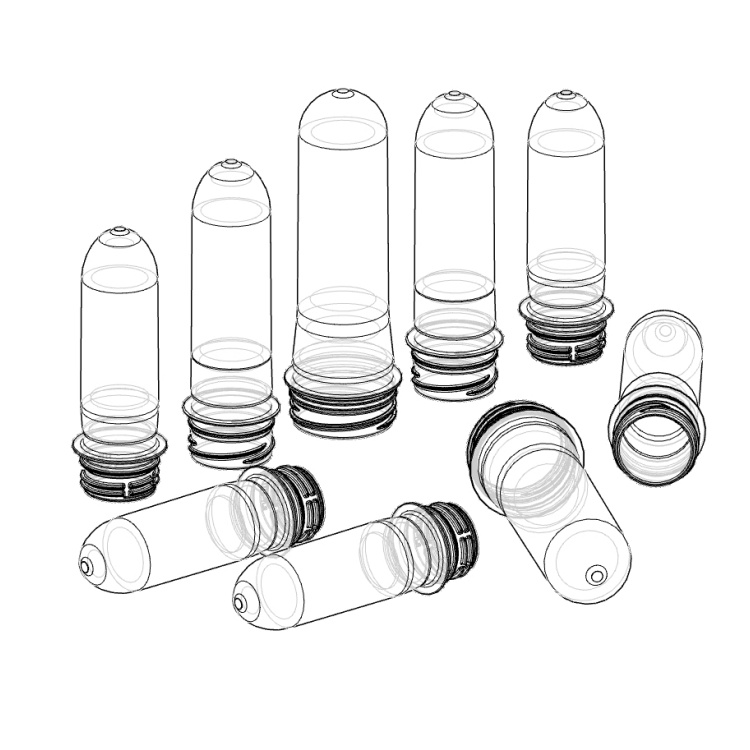
Before blowing, PET resin is first formed into a preform through injection molding. This preform is not a simple intermediate product. It decides many later results, including neck accuracy, wall distribution, surface finish, and how evenly the bottle can stretch during blowing.
The practical issue is how the PET material used in PET bottle blowing process behaves after it has already been molded into a preform. If the preform has unstable dimensions or surface defects, the blowing machine may only make the problem more visible.
Heating Stretching Blowing and Cooling
In the bottle blowing stage, the heated preform is stretched by the stretch rod. Pre-blow air starts forming the bottle shape, and high-pressure air pushes the material against the mold cavity. Cooling then fixes the final bottle shape before release.
Correct machine settings are still needed, but stable mold parts reduce cycle-to-cycle variation in preform shape, cooling, and release. That is why production teams should not treat every bottle defect as a resin issue.
Buyer Questions and Practical Checks
|
Buyer Question |
Practical Answer |
What to Check Next |
|
Are PET and PETE the same material? |
In most bottle packaging contexts, yes. |
Resin grade and preform design |
|
Does PETE need a different pet blowing process? |
No, not because of the name alone. |
Heating, stretching, pressure, cooling |
|
Will PET/PETE wording affect mold purchase? |
Usually no. |
Bottle drawing, neck finish, preform weight, mold part condition |
|
What affects final bottle quality more? |
Preform quality and mold stability. |
Mold Core, cooling tube area, mold part condition |
This table is simple, but it helps buyers avoid the wrong starting point. The material name may be clear, while the actual production problem may still need a tooling check.
How Do Preform Mold Parts Affect Final Bottle Quality?
The PET preform and bottle mold relationship is direct. A bottle is not only shaped in the blowing mold. Its quality is already influenced by the preform mold, mold core, cooling structure, and ejection action before it reaches the blowing machine.
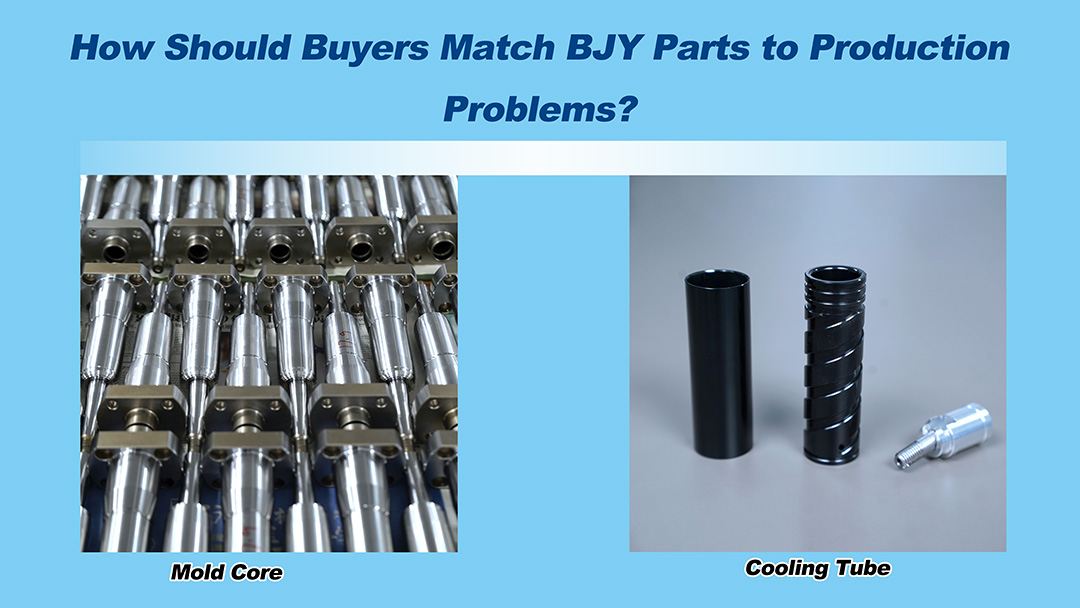
Before choosing replacement mold parts, buyers should first separate material problems from tooling problems. If the preform shows unstable inner shape, poor surface finish, or repeated dimensional variation, the Mold Core should be checked first. If the preform looks acceptable at release but changes after cooling, the cooling structure may need review. If the cooling channel, tube assembly, or heat removal path is unstable, the Cooling Tube is usually more relevant than changing the PET/PETE wording.
Mold Core for Preform Accuracy
If the preform shape is unstable from the beginning, the Mold Core should be checked before adjusting the blowing process again and again. The Mold Core affects the inner forming area of the preform, so wear, mismatch, or poor surface condition may carry defects into the later bottle stage.
This part is more suitable for buyers dealing with preform accuracy, inner surface quality, old mold refurbishment, or replacement of worn core parts. If a bottle project changes neck finish, preform design, or packaging application, the Mold Core should also be reviewed for compatibility.
Cooling Tube for Stable Preform Cooling
If the preform shows uneven cooling, neck-area dimensional drift, or repeated deformation after injection molding, the cooling tube area should be checked before adjusting the pet blowing process again. The Cooling Tube Assemble helps the preform mold remove heat more evenly, so the issue is tied to thermal control and part condition, not PET/PETE material wording.
This part is worth checking when old cooling tubes are blocked, worn, poorly matched, or no longer keeping each cavity consistent. For better matching, buyers should prepare the existing cooling tube sample, defect photos, mold drawings, and a clear description of the cooling problem.
How Should Buyers Match BJY Parts to Production Problems?
A practical purchase decision starts with the defect, not the product name. If the bottle wall is uneven, check the preform, heating, stretching, and blowing parameters. If neck or body dimensions change after molding, check the cooling tube area and mold part condition. If the preform inner shape is unstable, check the core forming area first.
Match the Symptom Before Choosing the Part
|
Production Symptom |
Area to Check First |
Suitable BJY Part |
Buyer Should Prepare |
|
Preform inner shape is unstable |
Core forming area |
Mold Core |
Preform sample, drawing, cavity details |
|
Preform changes after cooling or shows uneven deformation |
Cooling tube area |
Cooling Tube |
Cooling tube sample, defect photos, mold drawings, cooling details |
This kind of basic diagnosis helps avoid ordering the wrong spare part only because the final bottle defect looks similar. A cooling-related preform change, for example, is not usually solved by changing PET to PETE wording. It is more likely linked to the cooling path, tube condition, water flow path, or mold thermal balance.
Avoid Treating Every Defect as a Material Problem
A common mistake is to blame PET material when the real issue comes from tooling. Cooling-related dimensional change needs a different check from unstable blowing pressure or poor core forming. Before changing resin documents or process settings, buyers should confirm whether the same defect follows one cavity, one cooling tube position, or one batch of parts.
Before replacing parts, buyers should collect samples from stable and unstable cavities separately. This makes it easier to compare whether the problem follows the material batch, the mold cavity, or one specific mechanical part.
Check Drawings Samples and Machine Details
Before confirming mold components, prepare the preform weight, neck finish, cavity layout, machine interface, current part photos, and available drawings. If the part is only close but not properly matched, it may still create downtime.
For a new bottle project, start with material and preform design. For an existing line with recurring defects, start with the production symptom. Dimensional changes after molding may require a closer look at the Cooling Tube. Unstable preform shape or poor inner surface quality often makes the Mold Core worth checking first. If the PET/PETE wording is already clear, the next decision should be based on the real defect, the mold structure, and the part condition.
Project Support and Contact
If you are comparing PET/PETE material descriptions, checking preform defects, or preparing replacement mold components, send the basic project details first: bottle type, preform weight, neck finish, machine condition, drawings, and sample photos. BJY can review whether the issue is more likely related to Mold Core, Cooling Tube, or another mold part. For project discussion, use the contact page and describe the production problem clearly.
FAQ
Q: Are PET and PETE the Same Material?
A: Yes. In most plastic bottle and packaging production, PET and PETE refer to the same material, polyethylene terephthalate. The spelling does not change the basic bottle blowing method.
Q: Does PETE Need a Different Pet Blowing Process?
A: No. PETE does not need a different pet blowing process simply because of the name. The process depends on resin grade, preform design, heating control, stretching, air pressure, cooling, and mold condition.
Q: Which Mold Part Should I Check if PET Preforms Change Shape After Cooling?
A: Start with the cooling structure. If preforms show dimensional change, unstable neck areas, or repeated deformation after molding, the Cooling Tube may need inspection, replacement, or customization. If the problem is poor inner shape from the forming stage, the Mold Core may be more relevant.