

A Practical Guide to Plastic Forming for Industrial Applications
Plastic forming acts as the unseen force powering nearly every item you find on retail displays. This method converts simple plastic granules into dependable, transparent holders that contain items ranging from your breakfast beverage to the cleanser in your bath. For firms in the container sector, mastering this technique involves more than crafting a single vessel; it demands ensuring that vessel proves resilient, attractive, and affordable to fabricate. At BJY, such priorities have shaped routine efforts since 2011. Situated in Foshan’s Sanshui District, the group follows a basic adage: “A hundred feet pole, advance one step further.” This guides them to persistently pursue further advancements in mold creation.
If you seek approaches to streamline your assembly line, you have likely noticed that minor elements in the shaping method create the greatest effects. Whether managing rapid rotary devices or routine injection units, comprehending the methods and rationale of plastic forming represents the initial action leading to enhanced financial results. By focusing on these fundamentals, operators can achieve smoother workflows and reduced costs over time.
What Are the Key Stages in Injection Molding?
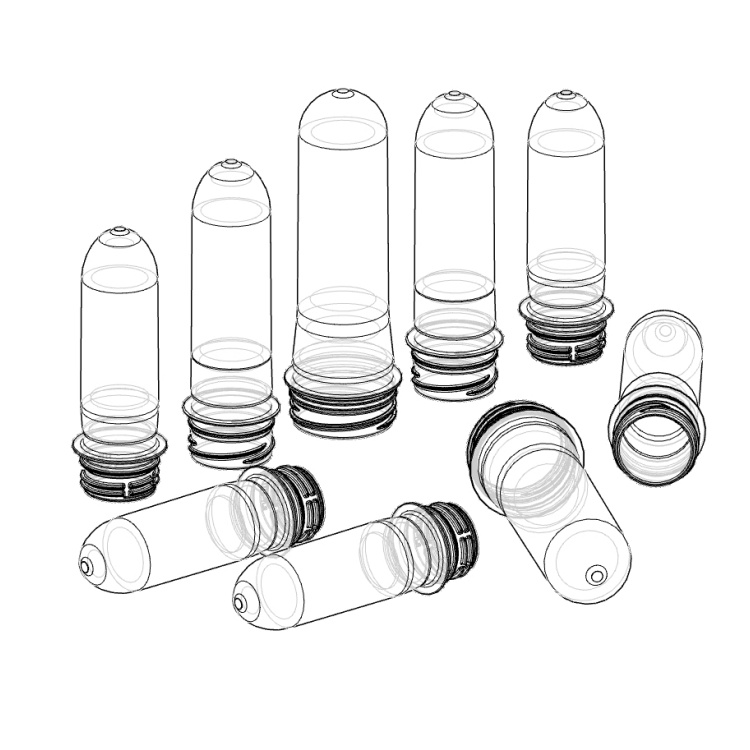
Prior to expanding a bottle to its complete form, it originates as a “preform,” which functions as a dense plastic cylinder complete with formed threads in the upper section. This opening phase demands substantial effort. Without a flawless preform, the end product will inevitably underperform. Below, we outline how expert arrangements at BJY manage this essential procedure.
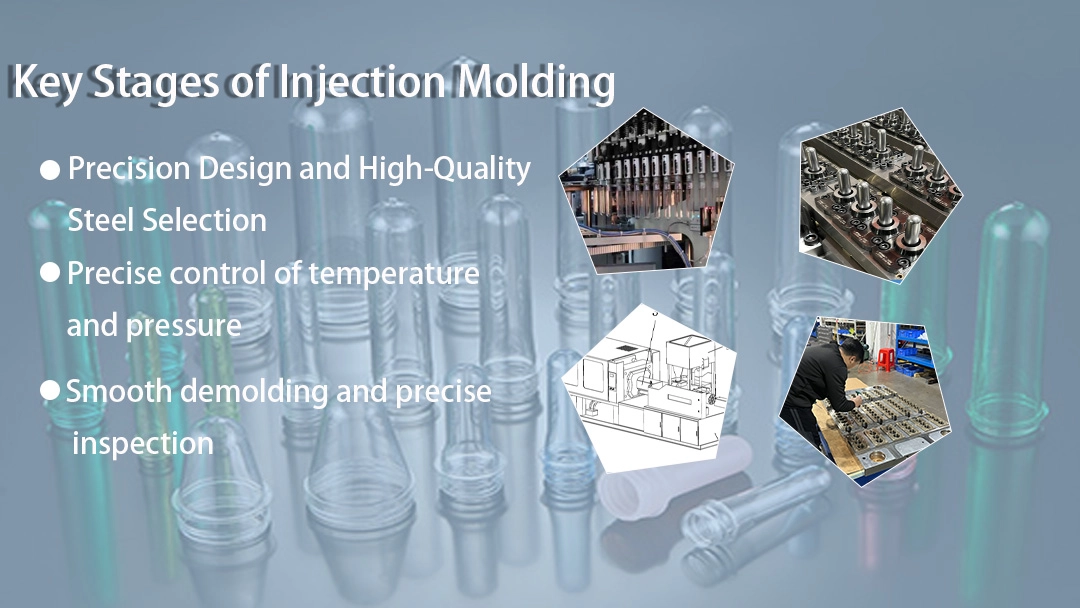
Smart Design and Picking the Right Steel
The process begins digitally with a detailed 3D model that incorporates each small bend. Ordinary materials will not suffice; production molds require premium, sturdy steel able to withstand elevated temperatures without deforming. BJY selects steel noted for its hardness and employs multi-axis CNC tools to carve forms with fine precision. As a result, this prevents issues like “eccentricity,” in which plastic layers differ in depth on opposite sides, from compromising entire lots.
Keeping the Heat and Pressure Under Control
When the mold stands prepared, liquid PET material gets pushed into the voids. Balancing force and pace proves crucial here. Excessive speed introduces voids, whereas insufficient velocity causes premature solidification before complete filling. For steady operation, the mold includes embedded cooling passages. These routes draw away warmth efficiently, allowing the material to solidify promptly, and thereby enabling the device to launch the following round without much wait.
Taking the Parts Out Without a Hitch
Following solidification of the material, the mold divides, and the preforms emerge cleanly. BJY routinely treats mold undersides with sandblasting to facilitate release and avoid adhesion that might halt the system. Subsequently, the items receive prompt evaluation. With advanced instruments such as Zeiss Coordinate Measuring Machines, experts verify sizes to 0.002mm accuracy, ensuring all aspects align precisely with requirements.

Why Is Equipment Compatibility Vital for Efficiency?
Plant overseers frequently encounter irritation upon purchasing a fresh mold that fails to mesh well with current apparatus. Without exact alignment, considerable time gets lost in fine-tuning. Genuine productivity stems from components designed for seamless integration with prominent sector leaders. Such compatibility reduces setup times and supports uninterrupted manufacturing flows.
Making It Work with the Big Brand Machines
Many large-scale operations depend on equipment from makers like Husky, Sidel, or Krones. BJY directs efforts toward ensuring their molds, including the 72 Cavities PET Preform Injection Mold, integrate flawlessly with these units. They align with required gripping strengths and thermal regulation, permitting quick installation and immediate commencement of runs.
Using Modular Parts to Cut Down Downtime
Operators cannot spare lengthy disassemblies for a single failing element. Hence, a segmented structure offers substantial benefits. Crafting replaceable sections turns upkeep into a quick 15-minute task rather than an extended disruption lasting half a day. Furthermore, this strategy allows transitions among various vessel masses or collar types without acquiring a full replacement mold collection.
Getting the Best Life Out of Your Spare Parts
The core components bearing the heaviest load in the mold consist of the Mold Core and the Lock Ring. These endure the harshest conditions. BJY fabricates them using strong metal blends and applies protective films, including DLC (Diamond-Like Carbon), to avert material cling and metal erosion through countless repetitions.
How Does Advanced Cooling Improve Production Quality?
The cooling stage often receives little attention, yet it decides the outcome of product standards. Irregular cooling renders the vessel fragile or opaque. Effective cooling transcends basic chilled liquid; it concerns the placement of flows and the speed of thermal transfer. Proper execution here guarantees robust and clear results consistently.

Using Precision Cores to Spread the Cold
Even distribution serves as the main aim. BJY’s water-cooled cores incorporate pathways that encircle the preform, extracting warmth from every direction simultaneously. Consequently, this averts material distortion during hardening, preserving steady layer depths in all mold sections.
Fighting Thermal Stress with Better Materials
Elevated temperatures strain metallic elements severely. Prolonged exposure to alternating warmth and chill gradually alters mold contours. Opting for materials with enhanced heat transfer, such as particular aluminum mixes, facilitates quicker dissipation compared to typical steel. BJY further applies oxidized coatings to these pieces, shielding them from decay amid daily contact with dampness and warmth.
Predicting Problems with Smart Simulations
Before any material gets processed, BJY runs digital analyses to trace heat movement across the mold. These reveal areas of prolonged softness in the material. Addressing them early in planning reduces frequent errors like depressions or enclosed gases, thereby sustaining optimal output levels.
Which Solutions Solve Common Molding Challenges?
Superior setups occasionally face minor setbacks. Bottles might display slim bases, or material could exhibit “whitening.” These typically link to distinct procedural segments. Targeted fixes can swiftly restore peak performance.
Fixing Uneven Walls and Centering Issues
Should vessel sides seem offset, inspect the Lock Ring first. It secures the central alignment of the core inside the void. BJY crafts these rings with precise limits, maintaining position stability despite intense filling forces.
Stopping Material Build-up and Wrinkles
Folds emerge commonly from uniform heating lapses or mistimed expansion. Substituting fatigued Mold Cores aids resolution, as they stabilize the preform’s core warmth. BJY polishes their cores to a reflective sheen, promoting fluid material passage without snaring or clumping.
Making Sure the Caps Always Fit Right
No fault irks more than a dripping container. Such escapes often arise from imprecise or blunt upper threads. BJY devotes particular care to the collar zone, conforming to worldwide benchmarks like PCO 1881 or 29/25. This practice assures a tight, impermeable closure upon machine application.
To explore further how these molds transform manufacturing, visit the BJY Official Website. Review their PET Injection Molds or scan the entire selection of exact parts.
FAQ
Q1: What is the fastest way to reduce cycle times on my PET line?
A: Improved cooling often yields the primary advantage. High-thermal conductivity molds or enhanced water-cooled cores extract warmth from the material more rapidly, facilitating earlier starts to subsequent rounds. These modest shifts accumulate to produce thousands more units per session.
Q2: Are BJY molds compatible with my European-made machines?
A: Yes, numerous items get engineered for alignment with key producers like Sidel, Krones, and Husky. They adhere to matching connection norms and air-driven controls, enabling frequent direct swaps for factory originals absent further design work.
Q3: How do I stop my preforms from sticking to the mold?
A: Attachment stems usually from excessively glossy or warm mold faces. BJY employs sandblasting on lower mold areas to form a texture aiding material detachment. Paired with superior cooling, it largely removes attachment concerns.
Disclaimer
The brand names and logos of sidel, husky, khs, sacmi, sipa, netstal, etc., are registered trademarks owned by their respective legal holders. All mentioned trademarks and brand names in this article are used solely for the purpose of illustrating product compatibility and suitability. BJY does not claim any rights to the aforementioned trademarks and has no affiliation, authorization, or partnership with the companies mentioned. Any references herein do not imply that our products are original factory parts or have received official recognition from the manufacturers.