

Casting vs Molding for Plastic and Metal Parts Which Process Works Best
Casting vs Molding is often reduced to metal versus plastic, but the decision is more technical. Casting fills a cavity with liquid material and allows it to solidify. Molding may use injection pressure, compression, stretching, or air. Material behavior, geometry, production volume, tooling cost, and maintenance all matter.
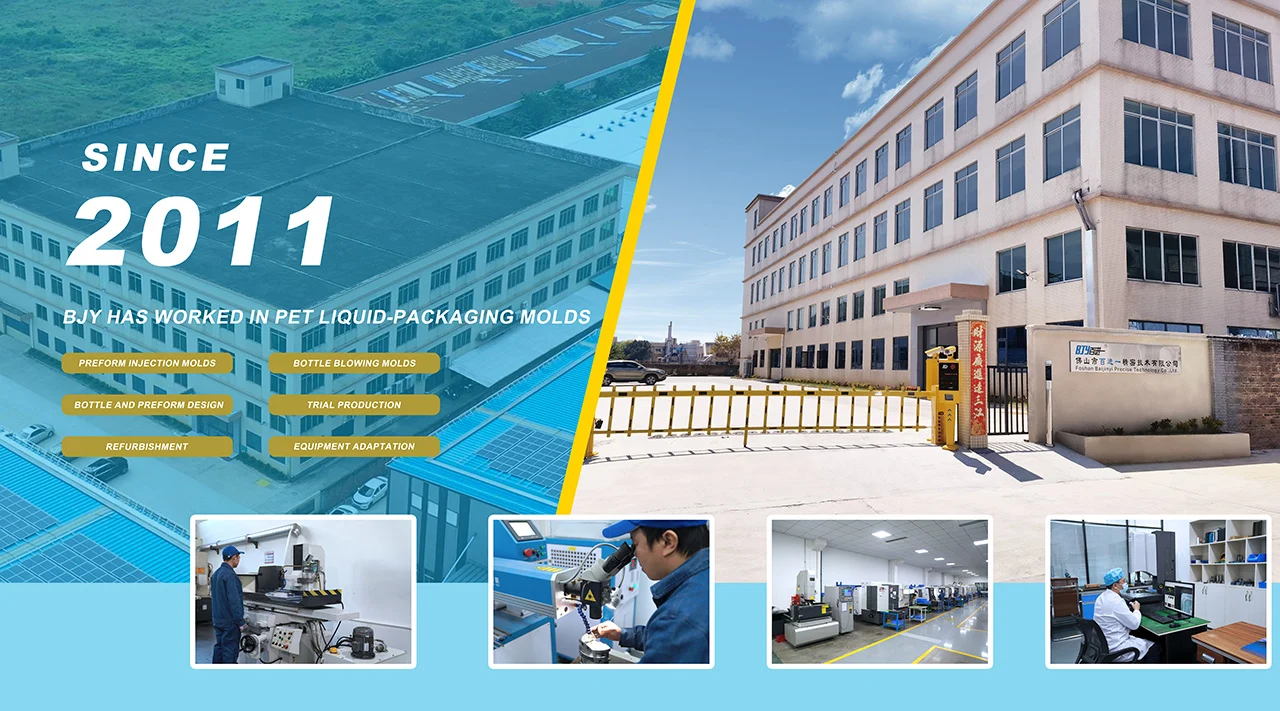
BJY has worked in PET liquid-packaging molds since 2011. Its scope includes preform injection molds, bottle blowing molds, bottle and preform design, trial production, refurbishment, and equipment adaptation. PET packaging is useful because the bottle passes through two molding stages.
What Is the Main Difference Between Casting and Molding?
The difference between casting and molding begins with material entry and applied force. Both still depend on cavity design, venting, heat transfer, shrinkage, and alignment.
Material Entry and Shape Formation
Casting places liquid material into a cavity, where it cools or cures into shape. Molding is broader. Plastic may be injected into a closed cavity, expanded by air, or pressed between matched surfaces.
Pressure, Cooling, and Solidification
Some casting methods rely on gravity, while others add pressure. Plastic molding combines heat, clamping force, pressure, and cooling. Poor thermal balance can cause incomplete filling or distortion.
Common Casting and Molding Methods
Casting routes include sand casting, investment casting, and pressure-assisted metal casting. Molding routes include injection molding, blow molding, compression molding, and rotational molding. A useful Casting vs Molding comparison must name the actual process.
Which Process Works Better for Plastic and Metal Parts?
For a practical Casting vs Molding decision, start with the final part specification.
Material Compatibility and Part Requirements
In design for metal parts casting is commonly used in order to increase the structural mass, to improve heat resistance and to create more complex geometries. In design for production of parts made from thermoplastics it is preferred to use molding, because in this way threads are easier to create, walls can be made thinner, surfaces can be made more even and parts with low mass can be created. In design for PET packaging a stable neck finish, a proper wall distribution and a proper sealing area have to be created.
Production Volume and Tooling Economics
A comparison of casting and molding costs would include: tooling, material, cycle time, machining, scrap, inspection and maintenance. What is cheap to make the tooling for, may cost more in additional processing for every part.
Accuracy, Surface Finish, and Design Complexity
Casting can reproduce very complex shapes and can often be left finished, but may require machining of the sealing faces and bores etc. However, molding can actually form features such as threads, ribs, label panels and thin walls directly as the material is molded, as long as the cooling and shrinkage is controlled.
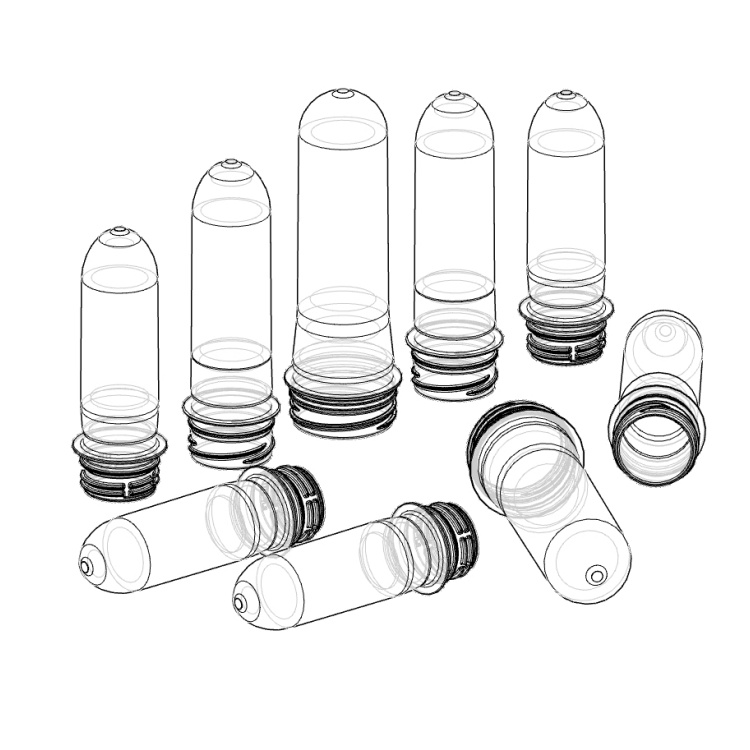
Casting is used for many of metal parts that require high strength or heat resistance. For the majority of plastic parts that are to be of a repeat configuration and have specific geometric tolerances, Molding is used. PET bottles are molded using injection molding to form the preform and the finished neckband, and blow molding to form the bottle body.
Where Does PET Packaging Fit Within Molding?
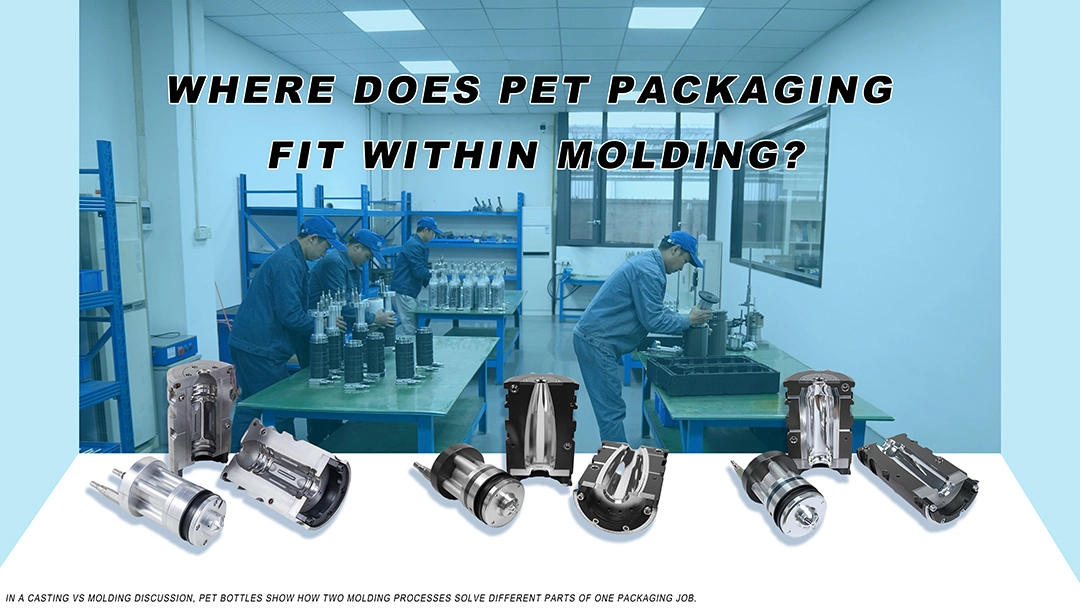
In a Casting vs Molding discussion, PET bottles show how two molding processes solve different parts of one packaging job.
PET Injection Molds for Consistent Preforms
For injection molding for PET preforms, the PET Injection Mold range supports 32, 48, 56, 72, 96, 128, and 144 cavity layouts. Neck formats include 28 mm variants, 26/22 mm, 29/25 mm, and 38 mm. The mold frame can use S136 at HRC 30–35.
Cavity balance, hot-runner flow, neck-ring alignment, and cooling must work together. Imbalance may cause uneven walls or sealing problems.
PET Blowing Molds for Finished Bottles
The PET Blowing Mold forms the reheated preform into the final container. BJY covers water, carbonated drinks, hot-fill, aseptic, edible-oil, and other liquid-packaging applications, with common capacities from 50 ml to 2,500 ml.
Material selection should follow the filling process, not bottle volume alone. A6061 or A7075 aluminum suits applications where heat transfer and lower rotating weight matter. Selected hot-fill structures use an S136 cavity with an A6061 base. Hot-fill mold bodies normally operate at 130–160°C. For cold-fill production, the mold body is generally kept at 35±10°C and the base mold at 7–12°C. Uneven heat transfer can affect bottle volume, stress, and base stability.
The Two-Stage Preform-to-Bottle Workflow
PET resin is injection molded into a preform with a finished neck, then reheated, stretched, and expanded by compressed air inside the bottle cavity. This PET bottle blow molding process allows the neck and bottle body to be controlled separately.
What Should Buyers Check Before Ordering a PET Mold?
A sound PET mold purchase starts with complete machine, preform, bottle, and filling-process data. Bottle volume alone is not enough.
Machine, Neck Finish, and Product Compatibility
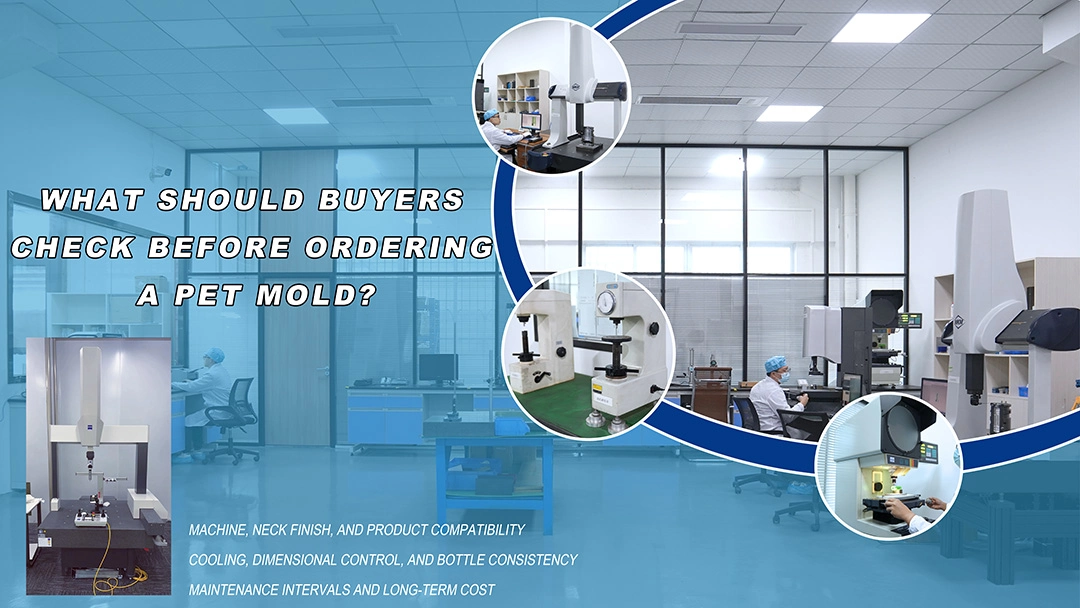
Provide the machine type, mounting dimensions, bottle capacity, preform weight, neck finish, filling temperature, and target output. Filling processes place different demands on the cavity, base, venting, and cooling circuit.
Two 500 ml bottles may use different neck finishes, preform weights, base geometries, and machine interfaces. A mold may fit mechanically yet still produce poor wall distribution or unstable base cooling. A practical PET mold selection guide should treat the bottle sample, machine drawing, preform data, and filling conditions as one technical package.
Cooling, Dimensional Control, and Bottle Consistency
Cooling-channel layout and temperature consistency affect stability. BJY uses hardness, thickness, pressure, image, projection, and coordinate measurement. Its coordinate measuring equipment has a stated detection accuracy of 0.002 mm, supporting checks on cavity position, neck dimensions, and fit.
Maintenance Intervals and Long-Term Cost
BJY’s guidance calls for cleaning forming surfaces and lubricating locating parts every 72 hours, polishing forming surfaces monthly or after 500 operating hours, and checking cooling channels each quarter. Scale, blocked vents, and worn locating parts may gradually increase scrap.
How Can BJY Support Mold Selection and Production?
The final Casting vs Molding decision requires drawings, samples, production conditions, and equipment interfaces.
Project Evaluation and Custom Mold Design
BJY can work from a bottle sample, drawing, sketch, or production requirement. The review covers bottle shape, preform structure, machine fit, filling method, and mold material. Drawings are prepared before machining.
Trial Production, Inspection, and Commissioning
The manufacturing route includes cutting, rough machining, finish machining, inspection, assembly, and trial testing. BJY can run small-batch trials. For batch components, a test piece can be checked before the remaining quantity enters production.
After-Sales Service and Contact
Support can cover adjustment, refurbishment, component replacement, neck or volume changes, and troubleshooting. Machine settings, defect patterns, and sample measurements make communication more useful.
For help deciding whether your project needs a preform mold, a bottle mold, or both, use the project contact channel with your bottle sample, neck specification, filling method, target output, and machine details.
For PET packaging, Casting vs Molding has a clear result: casting remains relevant to many metal components, while injection molding and blow molding are the working processes for preforms and bottles. The next step is to confirm material, machine interface, cooling, inspection, and maintenance access.
FAQ
Q: Is casting the same as molding?
A: No. Casting fills a cavity with liquid material and lets it solidify. Molding may use pressure, compression, stretching, heat, or air.
Q: Is blow molding a casting process?
A: No. Blow molding stretches and expands a heated preform against the mold cavity.
Q: How should buyers compare Casting vs Molding for a new product?
A: List material, geometry, volume, tolerance, tool and maintenance costs and end use. For PET bottles: also list preform, neck finish, filling, machine interface and cooling requirements.